In today’s fast-moving world, people want food that is convenient, long-lasting, and still healthy. One of the best ways to achieve this balance is through dehydration. But many people still ask an important question — does dehydration destroy nutrients, or does it preserve them?
The truth is, when done correctly, dehydration is one of the oldest and most effective methods of preserving food while maintaining most of its nutritional value.
What Is Dehydration?
Dehydration is the process of removing water from fruits and vegetables. By removing moisture, the growth of bacteria, mold, and yeast is prevented. This helps food last longer without needing artificial preservatives.
Unlike deep frying or heavy processing, dehydration mainly removes water — not the core nutrients.
How Dehydration Helps Preserve Nutrients
1️⃣ Protects Minerals
Minerals like:
- Iron
- Potassium
- Magnesium
- Calcium
are very stable during dehydration. Since minerals don’t break down with heat easily, dehydrated foods remain rich in essential minerals.
2️⃣ Retains Fiber Content
Fiber is extremely important for:
✔ Digestion
✔ Gut health
✔ Blood sugar balance
✔ Heart health
Dehydrated fruits and vegetables maintain almost all their fiber content, making them great for daily nutrition.
3️⃣ Concentrates Nutrients
When water is removed, nutrients become more concentrated.
For example:
Fresh grapes → Dehydrated → Raisins
You eat less quantity but get dense nutrition.
What Happens to Vitamins During Dehydration?
Some vitamins are heat-sensitive, especially:
- Vitamin C
- Some B Vitamins
However, modern dehydration methods use controlled low temperatures, which help preserve most of these vitamins.
Also, even if a small percentage is lost, dehydrated foods still provide strong nutritional value compared to highly processed snacks.
Why Dehydrated Foods Are Better Than Processed Snacks
Let’s compare:
| Dehydrated Produce | Processed Snacks |
|---|---|
| Natural nutrients | Artificial additives |
| No artificial preservatives | High chemicals |
| Natural sugars | Added refined sugar |
| Real fiber | Almost zero fiber |
Shelf Life Without Chemicals
One of the biggest advantages of dehydration is natural preservation.
Instead of using:
❌ Artificial preservatives
❌ Chemical stabilizers
❌ Synthetic additives
Dehydration uses nature — removing moisture.
This makes dehydrated foods cleaner and closer to their natural state.
Are Dehydrated Foods Good for Daily Diet?
Yes — when they are:
✔ Naturally processed
✔ No added sugar
✔ No artificial colors
✔ No preservatives
They are perfect for:
- Office snacks
- Travel food
- Kids lunch boxes
- Gym snacks
- Emergency food storage
The Science Behind Nutrient Retention
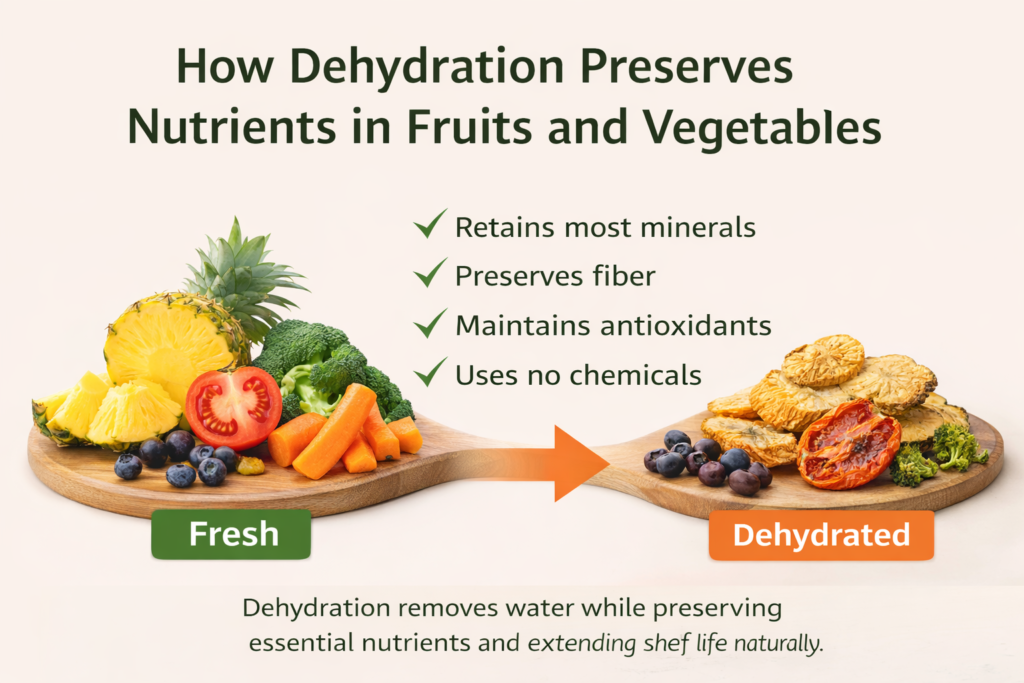
Studies show dehydration can retain:
- Most minerals
- Most fiber
- Many antioxidants
- Plant compounds like carotenoids & polyphenols
These compounds help fight inflammation and support immunity.
Best Way to Consume Dehydrated Produce
You can:
🥭 Eat as snacks
🥤 Add to smoothies
🥗 Add to salads
🍲 Add to soups
🍚 Add to cooking
Final Thoughts
Dehydration is not just about making food last longer — it’s about preserving nutrition naturally. When fruits and vegetables are dehydrated properly, they remain a powerful source of essential nutrients, fiber, and plant-based compounds.
In a world full of ultra-processed foods, dehydrated produce offers a clean, simple, and natural alternative.
If you’re looking for convenient nutrition without compromising health, dehydrated fruits and vegetables are a smart choice.
Hi, this is a comment.
To get started with moderating, editing, and deleting comments, please visit the Comments screen in the dashboard.
Commenter avatars come from Gravatar.